

When Ohio required schools to provide mental health education, Community Educator Amy Gladman wasn't simply looking for another lesson plan. She needed a curriculum that students would connect with, educators could confidently teach, and schools could successfully implement.
 Three years later, after teaching more than 18,000 students, one seventh-grade student recognized the signs of depression in a friend and spoke up. That conversation led to her friend receiving life-saving support.
Amy's experience reflects a question many school counselors, school social workers, and district leaders are asking today:
How do you choose a school mental health curriculum that truly makes a difference?
Choosing the right curriculum isn't simply about meeting a state requirement. It's about selecting a resource that helps students build mental health literacy, recognize the signs of depression, seek help when they need it, and support one another before a crisis occurs.
At Erika's Lighthouse, we've partnered with more than 6,500 schools in all 50 states. One thing we've learned is that successful implementation doesn't begin with the curriculum itself. It begins with u understanding what students need and the kind of school culture educators want to build.
The schools that see the biggest impact aren't the ones with the most resources. They're the ones that take time to understand what their students are walking in with, and then build from there. When a school starts with that question, everything else falls into place”
— Katie Conklin, Vice President of Programs, Erika's Lighthouse
Why This Decision Matters
Schools across the country are seeing an increased need for mental health education while balancing limited time, staffing, and resources. Half of all mental illnesses show up before age 14, and suicide remains the second leading cause of death for young people.
Many states now require or encourage schools to provide mental health education, but meeting a mandate is only one part of the equation.
The larger opportunity is creating a school environment where students understand mental health, know how to recognize when someone may be struggling, and feel comfortable reaching out to a trusted adult.
Questions to Ask Before You Compare Programs
One of the biggest mistakes schools make is evaluating curriculum before identifying what their students actually need.
Before evaluating specific curricula, take a step back and think about your school's needs. These questions can help guide your decision-making.
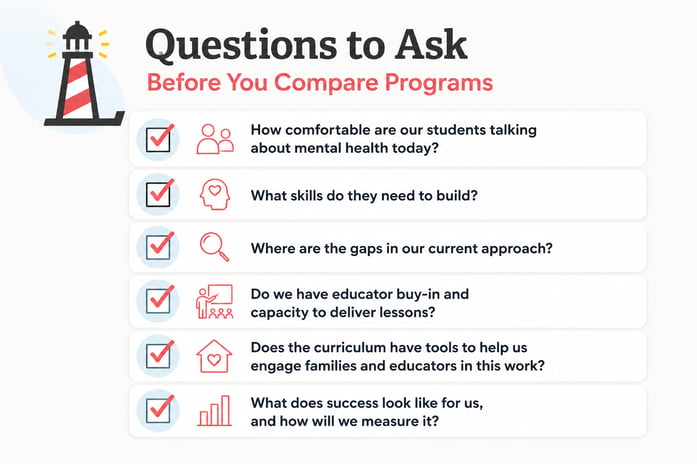
As you compare programs, ask:
-
- Are students comfortable talking about mental health?
- What skills do students still need to develop?
- Where are the biggest gaps in our current approach?
- Are educators prepared and supported to teach these lessons?
- How will families be included?
- How will we measure success?
The answers to these questions should guide your curriculum selection.
Understand Where the Curriculum Fits
Before selecting a program, it's important to understand how it fits within your school's overall mental health strategy.
Many districts use a Multi-Tiered System of Supports (MTSS) to organize student support. While crisis intervention and targeted supports are essential, they reach students after concerns have already surfaced.
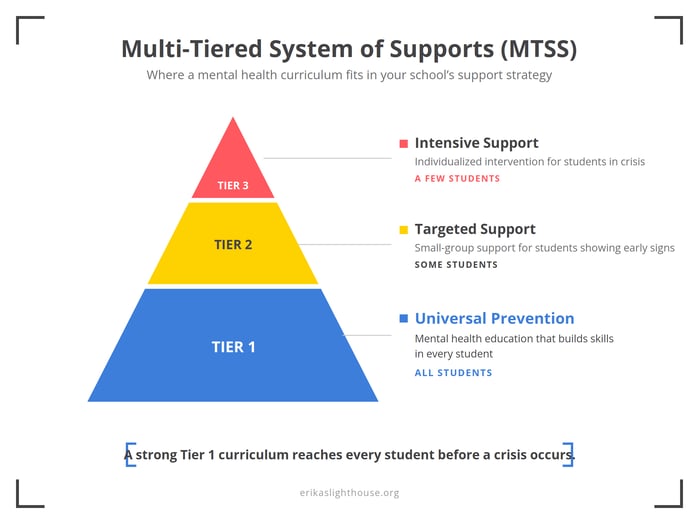
For most schools, the greatest opportunity lies in Tier 1 prevention: providing every student with the knowledge and skills to understand mental health, recognize the signs of depression, reduce stigma, and know how to seek help.
Universal mental health education creates a shared foundation before concerns become crises. This is what educators mean when they talk about working "upstream."
This approach also aligns with the Whole School, Whole Community, Whole Child (WSCC) framework, which recognizes that student well-being is shaped by the entire school environment, including classroom instruction, family engagement, staff support, and school culture.
What Effective School Mental Health Curricula Have in Common
They Teach Practical Skills
The strongest curricula move beyond awareness.
Students should leave each lesson knowing how to:
- recognize signs of depression
- identify trusted adults
- support a friend appropriately
- seek help for themselves
- reduce stigma
This is where outcomes become measurable. In Erika's Lighthouse pre- and post-program evaluations, 89% of students demonstrated core mental health literacy after completing our classroom education, meaning they could accurately identify overwhelming feelings and the signs of depression. Schools can use Erika's Lighthouse's Data Center to measure outcomes, track student learning, and make data-informed decisions about their mental health programs.
They Are Safe and Developmentally Appropriate
Many educators worry about discussing depression in the classroom. That concern is understandable, and a well-designed curriculum addresses it directly.
An effective curriculum should be evidence-informed, age appropriate, and built and regularly updated by credentialed mental health, public health, and education professionals. Third-party validation matters here too. Look for recognition such as a listing on the Suicide Prevention Resource Center (SPRC) Best Practices Registry.
"Within the last three years, I've had only four students out of more than 18,000 leave a lesson because it was emotionally triggering. Erika's Lighthouse's curriculum is accurate, understanding, and presented in a way that students can handle." "
— Amy Gladman, Community Educator, The Counseling Center
Students Need to See Themselves in the Curriculum
Students engage most deeply when they see themselves reflected in what they're learning.
"Students can recognize when something feels like an act or a script," says Britnee Weatherspoon, Head of Curriculum at Erika's Lighthouse. "That's why our videos feature real teens telling real stories."
That authenticity, along with relatable scenarios and opportunities for discussion, is what makes the difference. "When students see someone who looks and sounds like them speaking openly about depression and mental health, the shame around it starts to break down," Britnee says, "normalizing these conversations and reassuring them that they are not alone."
When students hear from other young people rather than only from an adult at the front of the room, help-seeking feels more possible.
Easy for Educators to Teach
Even the best curriculum won't make an impact if educators don't have time to use it.
Look for programs that provide:
- ready-to-use lesson plans, slide decks, and student workbooks
- educator guidance and training
- flexible, modular delivery options that fit a four-day health unit, a single advisory period, or anything in between
- materials in the languages your families speak, such as full English and Spanish versions
- ongoing implementation support
Schools are far more likely to sustain programs that fit naturally into existing schedules.
They Support the Whole School Community
Students don't experience mental health in isolation, and classroom lessons don't exist in a vacuum.
The most effective approaches include:
- classroom education
- educator and staff support, so every adult in the building can serve as a trusted adult
- family engagement
- student leadership opportunities
- ongoing implementation resources
This connected approach shows up in the data. In schools using holistic programming from Erika's Lighthouse, 15% more students successfully identified a trusted adult outside their home, and 11% reported increased comfort speaking to an adult about their mental well-being.
They Are Financially Sustainable
School budgets are stretched thin, and too many programs launch with a free trial only to lock districts behind a paywall after educators have invested hours in onboarding.
When evaluating cost, look past the sticker price to the full picture. Are training, translated materials, dashboards, and implementation support included, or do they carry hidden fees? Can the program scale from one classroom to a whole district without triggering a new pricing tier?
Truly free, mission-supported programs let districts direct scarce intervention funding where it's needed most: the students who need more than Tier 1 support.
A Quick Evaluation Framework
As you compare mental health curricula, evaluate each program against these six essential criteria. 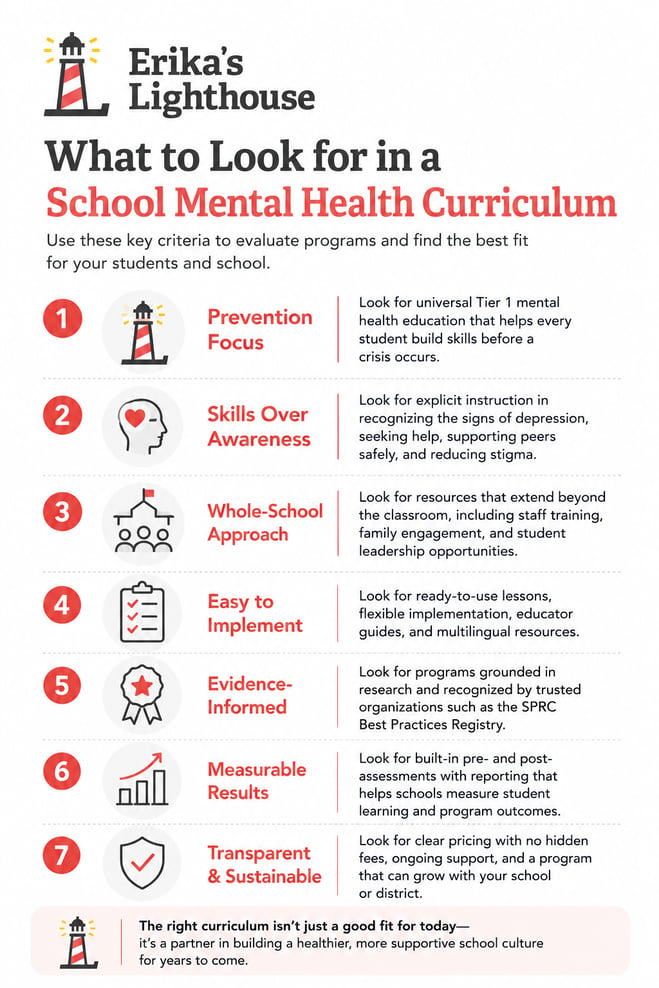
Questions to Ask a Curriculum Provider
Once you've narrowed your options, schedule a conversation with each provider. These questions can help you understand not only what's included in the curriculum, but also the level of partnership and support you'll receive.
- What evidence supports the curriculum's effectiveness?
- Who developed the curriculum, and what expertise informed it?
- How often is the curriculum reviewed and updated?
- What implementation support and professional development are included?
- How are families engaged in the learning process?
- Is the curriculum available in multiple languages and accessible to diverse learners?
- How are student outcomes measured and reported?
- What are the total costs, including implementation and ongoing support?
Learn from Other Schools
One of the best ways to evaluate a curriculum is to learn from educators and organizations that have successfully implemented school mental health programs.
Explore the Erika's Lighthouse blog for practical guidance, educator insights, research, and real-world stories from schools and community partners working to improve youth mental health.
Final Thoughts
Choosing a school mental health curriculum is about more than selecting lessons.
It's about investing in a resource that helps students recognize when they or a friend may be struggling, gives educators confidence to lead important conversations, and supports a healthier school culture for years to come.
Over the past two decades, we've learned that successful implementation isn't about finding the perfect curriculum. It's about giving educators the tools, confidence, and support they need to help students thrive.
The right curriculum doesn't simply meet a requirement.
It helps create a school community where every student knows they are not alone.
Ready to Evaluate Your School's Mental Health Program?
Erika's Lighthouse partners with schools to provide evidence-informed mental health education at no cost, spanning classroom education, family engagement, student leadership, and staff learning.
Choosing the right program begins with understanding your current landscape. Complete the free Tier 1 School Mental Health Assessment. It evaluates your student support ecosystem across seven focus areas, highlights program gaps, and provides custom recommendations for your district.
Take the Free Tier 1 School Mental Health Assessment
